Reusable rockets changed the guest list for space
Landing a booster is dramatic, but the quieter change is economic. When launch gets cheaper and more routine, new kinds of missions get a seat.
For decades the strangest part of spaceflight was treated as normal: the most expensive vehicle in the trip was thrown away after one use. Reusable rockets challenged that habit. The spectacular video is a booster falling back through the sky and landing upright. The deeper story is the spreadsheet behind the landing. If hardware can fly again, launch providers can spread development cost over more flights, learn from repeated use and offer missions that were once too expensive to consider. Reuse does not make space cheap in the ordinary sense. It does not remove physics, safety margins or launch risk. But it changes who can afford to try.
- The real change is flight rate
- Why rockets were thrown away in the first place
- Landing a first stage is a guidance and heat problem
- The second stage is much harder to reuse
- Cost falls when hardware flies often enough
- Three terms in a launch price, and only one of them shrinks
- Where the public numbers live, and what each one really says
- Cheaper launch changes the missions people dare to plan
- Reuse does not remove the hard parts of space
- When an expendable rocket still makes sense
- The next signal to watch is boring turnaround
- Three readings of reuse that keep coming back
- FAQ
This is for you if
- You know reusable rockets land, but not why that changes the market.
- You want a non-fanboy explanation of what reuse saves and what it does not.
- You follow satellite internet, lunar plans or space startups and need the cost logic.
Skip this if
- You want a detailed aerospace engineering derivation.
- You are looking for investment advice about launch companies.
- You only want a highlight reel of landings.
The real change is flight rate
A landing is proof that the vehicle survived the hardest part. The business value arrives only if it can be inspected, refurbished and flown again on a schedule. Reuse is less like catching a falling building and more like turning a custom machine into a fleet asset.
That is why flight rate matters. A reusable booster that flies once every few years is a museum piece. A booster that returns often gives engineers more data, spreads fixed cost and makes launch slots more available.
Why rockets were thrown away in the first place
Throwing hardware away was not foolish. Rockets operate near extreme limits. Engines shake, tanks empty, stages separate, and reentry punishes structure. For early programs, recovering hardware safely could cost more mass and money than building another stage.
The old model made sense when launch demand was limited and each mission was treated as a special event. As satellite demand grew, the waste became harder to ignore. Aircraft do not become useful by flying once. Launch vehicles moved slowly toward the same question.
Landing a first stage is a guidance and heat problem
The first stage is worth recovering because it contains large engines and expensive structure. It also separates early enough to return. The hard part is controlling a tall, mostly empty cylinder through high-speed air, engine relights and a final landing burn with very little margin.
The vehicle has to know where it is, keep the engines stable, survive heating and hit a small target. A tiny error near the end can erase the value of the whole recovery. That is why landing reliability took years of failures, data and iteration.
The second stage is much harder to reuse
The second stage travels faster and farther. To reach orbit, it gives the payload the final push. Bringing it back means surviving orbital reentry, adding heat protection and carrying extra mass that might otherwise be payload.
That is why many systems recover only the first stage. Full reuse remains the bigger prize, but partial reuse already shifts cost and cadence. The practical question is always what extra mass, complexity and turnaround time are worth paying for.
Cost falls when hardware flies often enough
A reusable rocket saves money only if the recovery system, inspections and refurbishment cost less than building a new booster. The first few flights may not prove much. The fleet improves as teams learn which parts wear out and which inspections can be simplified.
This is similar to reliability in aviation or shipping. The machine becomes cheaper not because it is simple, but because repeated operation turns unknowns into known maintenance tasks. Reuse is a learning system.
The number that matters is refurbishment cost divided by flights flown, not the simple fact that a booster was recovered. A stage only turns cheap when it flies often and each turnaround stays cheap. Recover it once at a high refit cost and the savings barely move.
Three terms in a launch price, and only one of them shrinks
The section above gives the logic. This one turns it into arithmetic you can run. If you came looking for a cost-benefit analysis of rocket reusability, this is where it actually lives. Put the dollar figures aside for a moment and call the cost of building one new first stage 1 unit. Measure everything else against that unit, and a single launch becomes three terms added together.
- Hardware amortised = 1 ÷ n, where n is how many times the stage flies. Fly the same stage five times and each flight carries 0.2.
- Recovery and refurbishment = r. Retrieval, inspection, replaced parts, transport, reassembly. Paid once per flight.
- Fixed cost = f. Pad time, ground crew, payload integration, insurance, propellant. An expendable rocket pays this too.
One flight therefore costs roughly 1/n + r + f. An expendable vehicle has no r, but its hardware never amortises, so it sits at 1 + f. Put a number on r and f and the two paths compare directly. The table below uses r = 0.1 and f = 0.3, which are illustrative rather than any real vehicle's figures. The shape is the point.
| Flights n | Hardware 1/n | Cost per flight | Against expendable at 1.30 |
|---|---|---|---|
| 1 | 1.00 | 1.40 | 8% more expensive |
| 2 | 0.50 | 0.90 | 31% cheaper |
| 3 | 0.33 | 0.73 | 44% cheaper |
| 5 | 0.20 | 0.60 | 54% cheaper |
| 10 | 0.10 | 0.50 | 62% cheaper |
| 20 | 0.05 | 0.45 | 65% cheaper |
Three things in that table repay a pause. The first row is the counter-intuitive one: recover a stage and never refly it and you have spent the recovery money while amortising nothing, which is worse than throwing it away. The steep part of the curve sits entirely in the early flights, where going from one to three swings the result by more than fifty points, while going from ten to twenty adds three. Once 1/n is small, the expression is governed by r and f alone.
That third point explains what the industry is actually competing on. The contest is how fast a stage can fly again and how few components an inspection has to open, not who holds the reuse record. Flight count stopped being the binding constraint some time ago. Run it the other way to feel how sharp this is: set r to 0.5 instead of 0.1 and twenty flights still cost 0.85 each, a saving of 35%. Expensive refurbishment cannot be outrun by flying more often.
Two costs are missing from that expression. A recoverable stage carries legs, grid fins and landing propellant, so it costs a little more to build and lifts a little less. Compared per kilogram to orbit, the advantage above narrows further.
Where the public numbers live, and what each one really says
Writing the formula is the easy half. Filling in n, r and f is not. No operator publishes r or f, so both have to be inferred backwards from advertised prices. Flight counts and advertised prices, on the other hand, sit on public pages. Here is one of them.
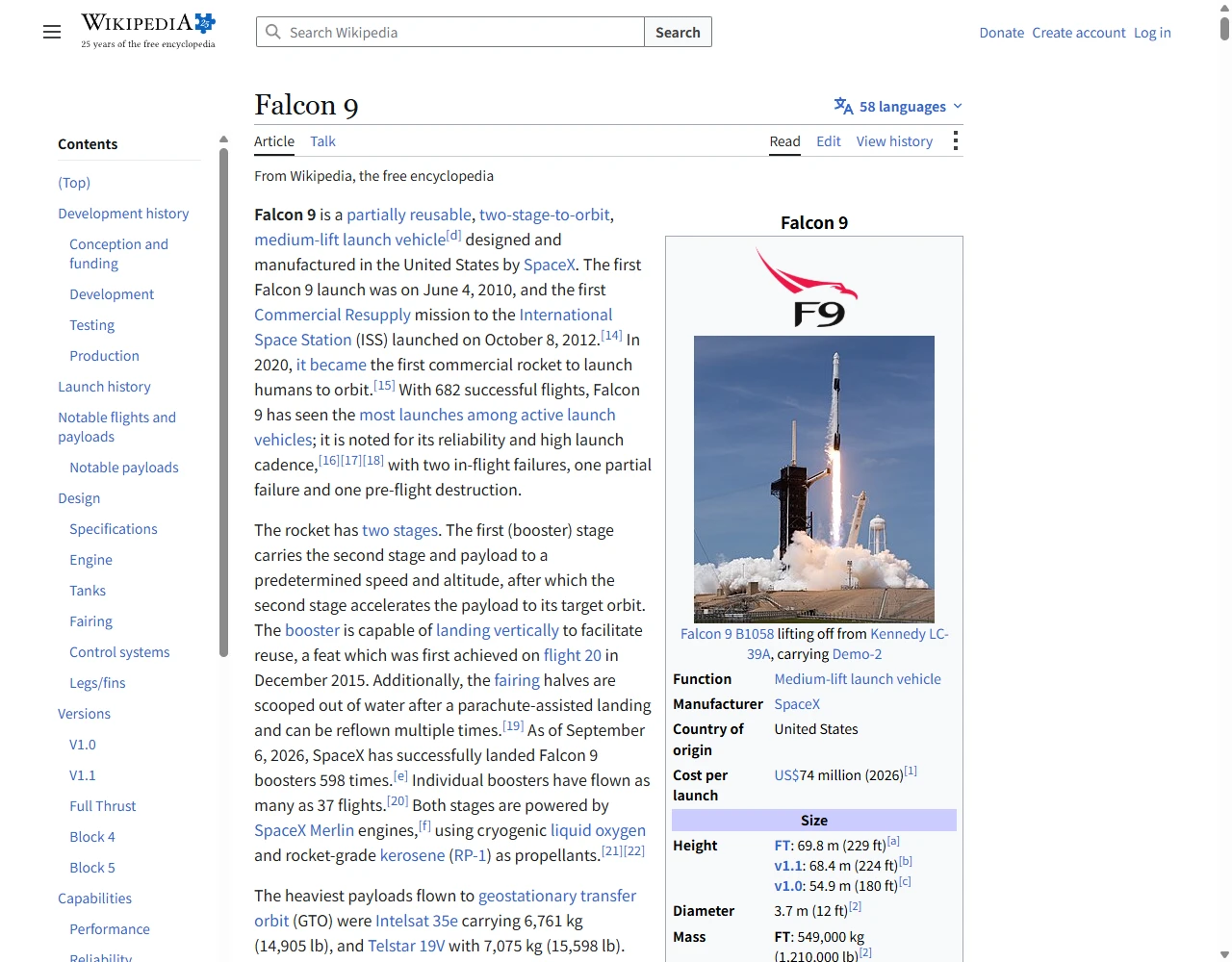
The text says that as of 6 September 2026 boosters had landed successfully 598 times, that one booster has flown as many as 37 times, and that the family has 682 successful flights behind it. The infobox lists cost per launch at US$74 million (2026), with a citation attached.
Those figures are usable, as long as you use them for what they are. The 74 million is a list price. It is not what the vehicle costs to build, since margin and overhead sit in between, and it is not what you would pay either, because unusual orbits, schedule priority, insurance and payload integration are billed separately. The 37 flights is one booster's record rather than a fleet average. Drop it straight into n above and you have modelled the best stage in the fleet, not the fleet.
Now the counter-example. The same encyclopaedia carries a page comparing launch systems across countries, and a fair amount of price journalism is copied out of it.
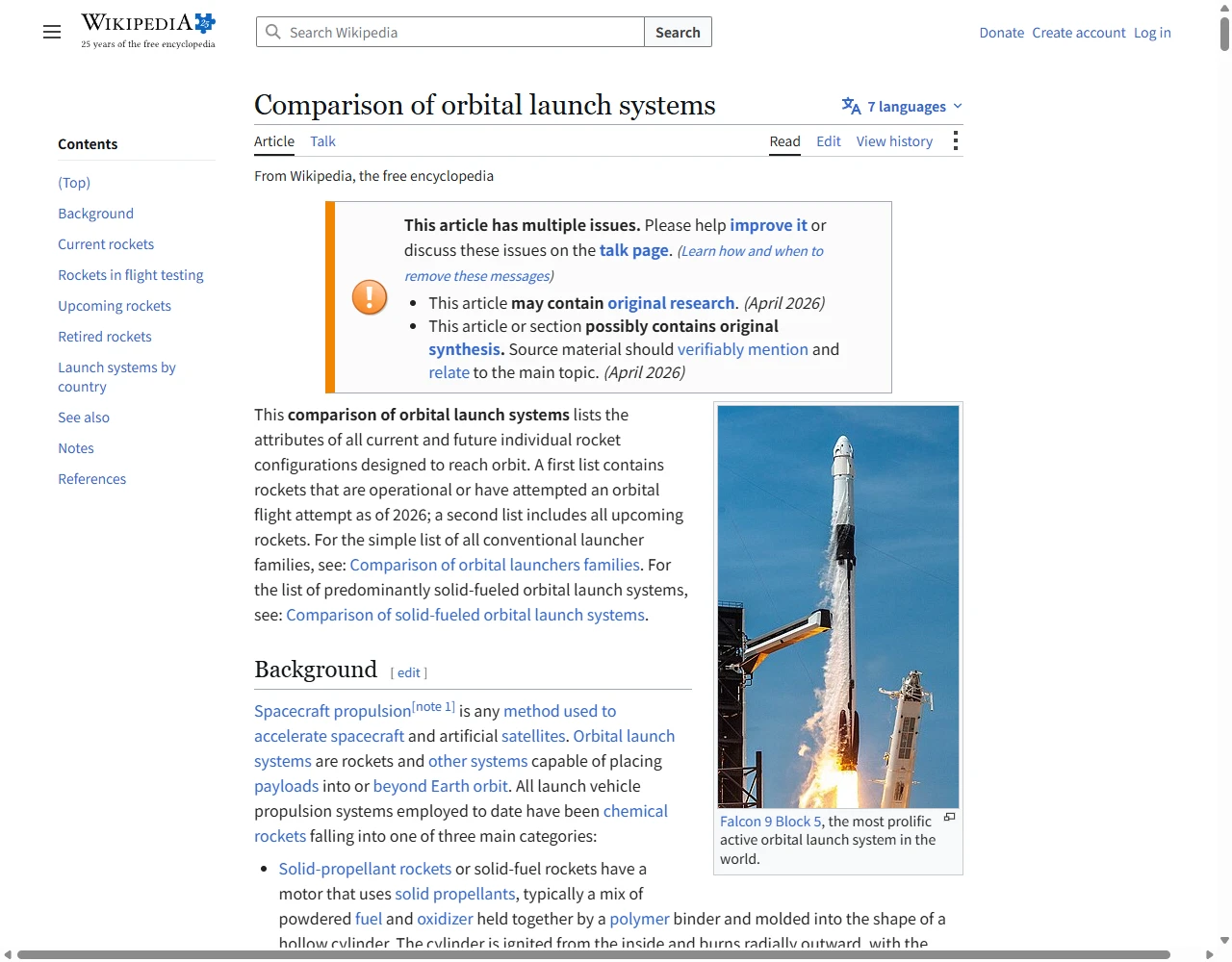
The banner across the top is the site's own: the page may contain original research, may contain original synthesis, and editors are asked to supply sources that state the material directly. The table that shows you every rocket's price in one view may well be one editor's assembly of figures from different years under different definitions. The more comprehensive a price comparison looks, the more it is worth checking whether it carries a warning about itself.
Before you commit a number to the formula, put it through four questions.
- Price or cost? A list price contains margin and allocated overhead. Blurring the two is how most claims that cost fell by some factor get manufactured.
- Which year? Launch prices are revised every few years, and an undated price cannot be used.
- What is included? A dedicated launch price usually excludes insurance and payload integration; a rideshare price per kilogram usually arrives with orbit and mass constraints.
- Dedicated or rideshare? Buying a whole rocket and buying a slot on someone else's are different products and do not belong in the same column.
None of this is a reason to distrust everything you read. It tells you what the number you are about to use actually measures. Every value you enter for n, r or f should have an answer to at least one of those four questions; if it has none, it is not ready to carry a conclusion.
Cheaper launch changes the missions people dare to plan
Lower launch cost lets operators build larger satellite constellations, universities fly instruments, startups test hardware and researchers accept missions that once looked too expensive. It can also make replacement and upgrade cycles faster.
The change is not only price. Schedule matters. If launch is more frequent, a failed experiment is not the end of a program. Teams can iterate. That is often what moves a field from showcase to industry.
Reuse does not remove the hard parts of space
Payload integration, range safety, weather, orbital mechanics and regulatory approvals still matter. Launch is only the first leg of a mission. Satellites still fail, debris still accumulates, and space remains an unforgiving operating environment.
A cheaper ride can even create new problems. More launches and more satellites mean more traffic, more coordination and more responsibility for deorbit plans. Access improves, but stewardship becomes harder.
When an expendable rocket still makes sense
Some missions need every kilogram of performance. Some vehicles fly too rarely for reuse to pay. Some national programs value independent capability more than the lowest commercial price. Expendable launch is not automatically obsolete.
The better comparison is mission by mission. What payload mass, orbit, schedule, reliability and political requirements are involved? Reuse is a tool, not a religion.
The next signal to watch is boring turnaround
Spectacular firsts get the headline. The more important milestone is routine turnaround: how often the same hardware flies, how much work sits between flights and whether customers treat reuse as normal.
When reuse becomes ordinary, space plans change. The guest list widens from national agencies and giant contractors to schools, small firms, science teams and new infrastructure builders. That is the real story.
| Question | Reusable first stage | Expendable vehicle |
|---|---|---|
| Hardware cost | Spread across flights | Paid each mission |
| Performance | Some mass reserved for return | Maximum one-way performance |
| Turnaround | Inspection and refurbishment | Build or prepare new vehicle |
| Best fit | Frequent launch markets | Rare or high-energy missions |
| Risk focus | Reuse wear and maintenance | Manufacturing consistency |
- Look for flight rate, not only landing success.
- Ask what parts are reused and how much refurbishment is needed.
- Separate launch price from total mission cost.
- Watch debris and deorbit planning as launch becomes more frequent.
Three readings of reuse that keep coming back
It lowers an important cost, but payloads, operations and risk remain expensive.
The larger innovation is repeatable refurbishment and operations.
Some missions still favor maximum performance or specialized requirements.
FAQ
Why recover the first stage first?
It is expensive, separates early and returns from a less extreme environment than the second stage.
Does reuse make rockets less safe?
Safety depends on inspection, design margins and operational history. Reused hardware can be safe when the process is mature.
Will reusable rockets reduce space debris?
They reduce discarded booster hardware in some phases, but satellite debris depends on spacecraft design and deorbit behavior.
Is full reuse coming soon?
Several programs are trying. The physics and economics are harder than first-stage recovery.
How many times can one booster fly?
There is no fixed number; it depends on how far a particular model has been proven. A company's stated ceiling says little on its own. The useful figures are how many flights a booster has actually completed while still in regular service, and how much inspection and refurbishment sits between one flight and the next.
How much does reuse actually save on a launch?
Public figures are mostly prices, not costs, so treat any specific number with care. The structure is easier to pin down: reuse saves the cost of building a new first stage and adds the cost of recovery, transport, inspection and refurbishment. How reusability impacts rocket launch costs in the end depends on whether a booster flies often enough for the saving on hardware to outweigh the added work. The section on the three terms in a launch price works through the arithmetic.
Sources & further reading
- nasa.gov: Public background on launch systems and space missions.
- spacex.com: Launch provider information on reusable booster operations.
- esa.int: European space agency context on launch and orbital infrastructure.
Updated: June 14, 2026. Two sections, on the three terms in a launch price and on where the public numbers live, were added on September 9, 2026, and two FAQ answers, on how many times a booster can fly and how much reuse saves, on September 14, 2026.

Fang Yu is the editor of FutureLens, turning published papers, official materials and public explanations into plain-language notes. He is most interested in the gap between a technology's public pitch and the evidence a careful reader can actually check. More about the author