Stablecoins Explained: What USDT and USDC Really Are
They are not exciting, but they are the closest thing to actual money inside crypto, and by far the most used. Here is what a stablecoin is, what holds it stable, where it can break, and how to try one without getting burned.
Most crypto tokens are built to swing in price. Stablecoins are the odd ones out: they are designed to sit still, to stay worth about one dollar no matter what the market does. USDT and USDC are the two best known. What follows covers what a stablecoin is, how it is tied to the dollar, what holds that peg together, where it can break, and how to try one without getting burned. No coin is recommended.
The short answer: a digital dollar for crypto
A stablecoin is a crypto token pegged to a national currency, usually the US dollar. In plain terms, it wants to act as a digital dollar inside crypto. "Pegged" simply means the token is meant to track one dollar as closely as possible, instead of rising and falling like Bitcoin.
Why build this at all? Because crypto assets are too volatile to price things in, settle with, or park money in during a rough patch. A stablecoin fills that gap. It runs on a blockchain, a public ledger no single party can quietly rewrite, so it moves across the world in minutes like any other token, yet its price stays roughly locked near a dollar. You get the convenience of a transfer without the heart-stopping swings. That is the whole reason it exists.
How it actually relates to the US dollar
The first reaction is usually, "So a stablecoin is just a dollar, right?" Not quite. A 1:1 peg means the issuer promises that each token you buy is backed by roughly one dollar of real assets, such as cash or short-term government debt, and can in principle be redeemed for a dollar. In the ideal case, one token is worth one dollar.
But keep this firmly in mind: a stablecoin is not a bank deposit. Dollars in your bank come with deposit insurance and regulation behind them. A stablecoin is a token issued by a company, and whether it holds its value depends on whether that company really has the money, tells the truth, and stays solvent. The peg is a design goal and a promise, not a law of physics. It does track a dollar most of the time, but "most of the time" and "always" are separated by the risks below.
Three ways the peg is held
Tokens that all get called "stablecoins" can hold their peg in completely different ways. Understanding the mechanism tells you which kind you are actually holding and where the danger sits. There are three main approaches.
Fiat-backed. This is the easiest to grasp and the model behind USDT and USDC. For every token issued, the issuer holds roughly one dollar of real reserves at a bank or custodian, a third party that safeguards the assets. What you trust is that the company genuinely holds the money and can redeem on demand. The weak point is transparency: how open the reserves are, whether audits are credible, and how trustworthy the issuer is.
Crypto-backed. Instead of dollars in a bank, this type uses other crypto assets, such as Ether, as collateral. Because that collateral itself moves in price, these systems usually over-collateralize, locking up say 1.50 dollars of crypto to issue 1 dollar of stablecoin, to leave a cushion. It is more decentralized and more transparent, since the collateral is visible on-chain, but a sharp drop in the collateral can trigger cascading liquidations, and the mechanism is more complex.
Algorithmic. This kind holds little or no equivalent collateral. It leans on an algorithm and market incentives to push the price back toward a dollar. It sounds clever, but history is unkind here: in 2022 a sizable algorithmic stablecoin lost its peg and collapsed toward zero within days, wiping out many holders. Algorithmic designs are widely seen as the most fragile of the three. As a beginner, treat the phrase "peg held purely by an algorithm" as a reason to slow right down.
| Type | How the peg is held | Transparency | Main risk |
|---|---|---|---|
| Fiat-backed | Equivalent cash or short-term debt held in custody, redeemable 1:1 | Varies with disclosure and third-party audits | Short reserves, false audits, issuer default |
| Crypto-backed | Over-collateralized with other crypto assets, visible on-chain | Higher, collateral is publicly checkable | Cascading liquidations if collateral crashes |
| Algorithmic | Little collateral, an algorithm nudges supply and demand | Mechanism is public but the least stable | Loss of confidence means depeg, has hit zero before |
What problem it really solves
Set the hype aside and stablecoins are one of the few crypto things with real, large-scale demand. Their strength lines up with what blockchains are actually good at: moving value quickly where no trusted middleman exists, something I cover in what blockchain actually solves.
Cross-border transfer and settlement. A traditional international transfer passes through several banks, takes days, gets nibbled by fees, and can stall. A stablecoin transfer ignores borders, often arrives in minutes, and no single institution can unilaterally block it. For people running small import-export businesses or sending money to family abroad, that speed is a genuine need, not a gimmick.
A parking spot during volatility. When the market is swinging hard, traders move assets into a stablecoin to sit in something that barely moves, then decide their next step. It is the crossing point that people pass through as they go in and out of trades.
A unit of account where the local currency is shaky. In places where the local currency loses value fast and dollars are hard to get, a token that tracks the dollar and moves anytime becomes a practical way for ordinary people to hold purchasing power. Note the word practical. It does not mean risk-free, and none of the risks below go away.
Where a stablecoin can let you down
On March 10, 2023, Silicon Valley Bank collapsed. Circle disclosed that 3.3 billion dollars of USDC reserves, about 8% of the total, were sitting at that bank and could not be reached. The next day USDC slipped below one dollar, and it took several days to climb back. A token built to sit still at a dollar tends to fail in one of three places.
- Depeg. A depeg is when the token slips off its dollar peg and no longer trades at one dollar. Sometimes it is a brief wobble that recovers in minutes. Sometimes, as with a failed algorithmic coin, it never comes back. The peg is a promise, not a guarantee, and it can break during market panic or reserve trouble. USDC broke it during the Silicon Valley Bank episode; USDT briefly fell to 88 cents in October 2018; and the algorithmic coin UST slid toward zero in May 2022 and never came back.
- Issuer and reserve trust. A fiat-backed stablecoin is really a bet that the company holds the money it claims. If the reserves fall short, the assets are misused, or the disclosures are false, the token may not redeem. Whether reserves are transparent and independently audited is central to judging any stablecoin. Both big issuers publish reports, on different schedules, compared in the next section. Most of what they publish are attestation reports, which check the assets on a given day; that is narrower than a full audit.
- Regulation and freezing. Legal treatment varies a lot by region, some places restrict or ban ordinary use, and the rules keep changing. On top of that, some centralized issuers technically have the ability to freeze tokens at a specific address under certain conditions. Check the rules where you live before assuming you can use one freely. Freezing is not theoretical: in November 2023 Tether, working with OKX, froze about 225 million dollars of USDT.
USDT or USDC: which to hold?
These are the two largest fiat-backed stablecoins, and beginners constantly ask which to pick. What follows sticks to public facts and practical use. It does not praise or attack either one, and it is not a recommendation.
Start with what can be checked. This table lists public facts only and does not score either coin:
| USDT | USDC | |
|---|---|---|
| Issuer | Tether, which moved its headquarters to El Salvador in January 2025 | Circle, listed on the New York Stock Exchange in June 2025 |
| What the reserves hold | Mostly US Treasuries, plus gold, bitcoin, secured loans and other assets | Cash, plus a BlackRock-managed money market fund holding short-dated Treasuries and overnight repos |
| How often it reports | A quarterly attestation, by the accounting firm BDO since 2022 | Reserve holdings every week, and a monthly attestation from a Big Four firm |
| Has it lost the peg? | Briefly fell to 88 cents in October 2018 | Fell below a dollar during the Silicon Valley Bank failure in March 2023, back within days |
| Can it freeze addresses? | Yes, and it has | Yes |
| In the EU | Not authorized under MiCA; regulated platforms have delisted or restricted it for European users | Circle obtained a French e-money license in July 2024 and issues USDC under MiCA |
The two sets of differences answer two different worries. If your worry is the money on the issuer's books, USDC reports more often and holds only cash and short-dated Treasuries. If your worry is getting out, USDT has more trading pairs and deeper markets, and almost every exchange takes it. Both are tokens issued by private companies, both carry every risk from the previous section, and switching from one to the other does not make you safe.
For deciding what to hold, the use matters more than the brand. If the coins only pass through an exchange and get spent within hours or days, hold whichever one your trading pair needs; over that span the difference is small. If you plan to park a meaningful amount as cash for weeks or longer, splitting it between the two keeps one issuer's trouble from becoming all of your trouble. If you live in the EU, check which one your platform still supports. Neither is a bank deposit or carries deposit insurance, and direct redemption with the issuers is aimed mainly at businesses and large clients, so for most people getting back to dollars depends on buyers at an exchange.
Once you have picked, one step is easier to get wrong: which platform you use and which network you send it on. The same USDT sent over different blockchain networks has different fees and address rules, and picking the wrong one can lose the coins outright. I built a withdrawal network picker for exactly that check, so run it before you transfer.
Stablecoin risk: holding USDT or USDC, and what to check each month
Once you have picked by use, give yourself a simple rule and a short monthly check. The rule: money that only passes through an exchange for a few days goes in whichever coin the pair needs; money you would miss, parked for weeks, gets split between the two, with the larger share in the one your own platform lets you withdraw and sell most easily; in the EU, hold USDC. The check takes five minutes and covers three things.
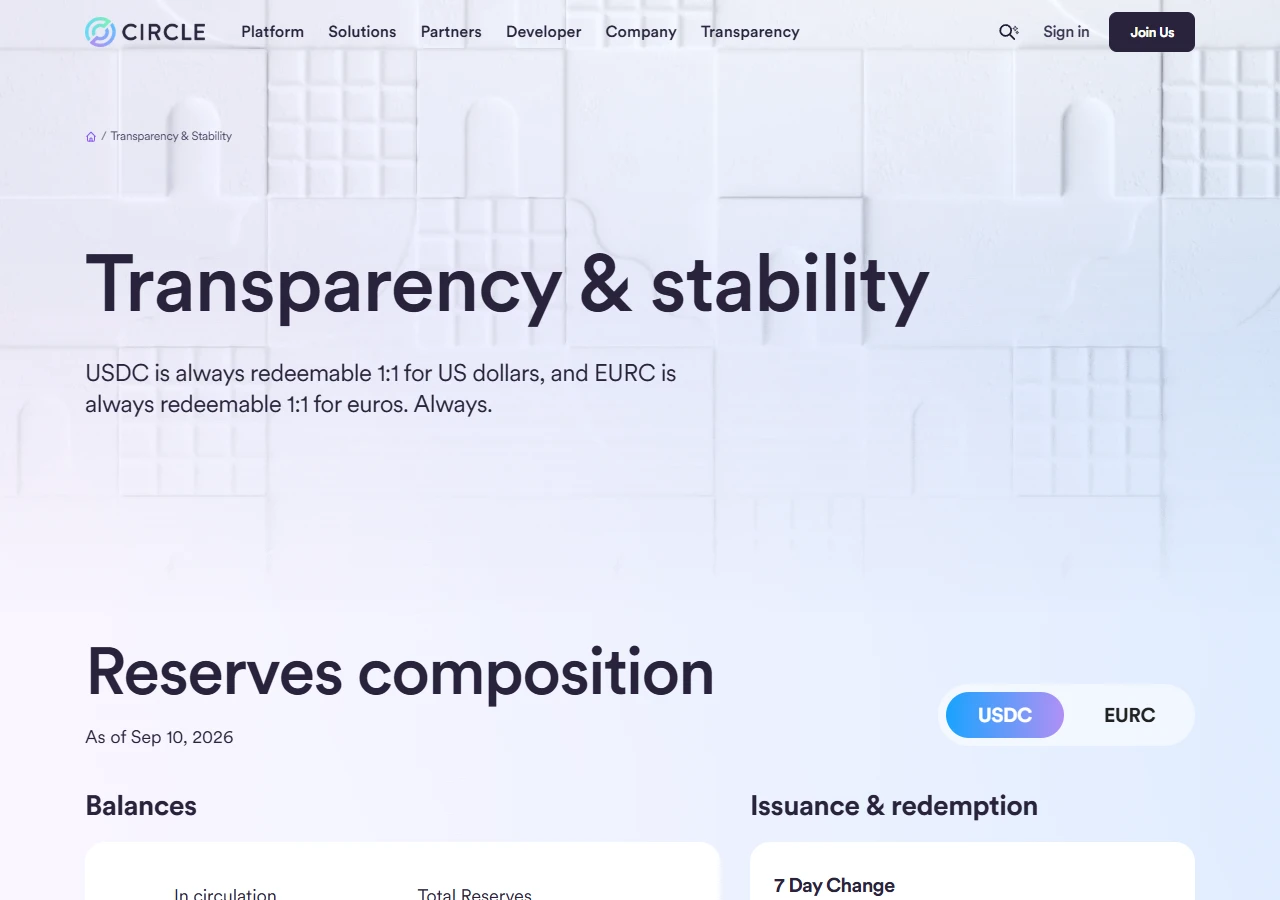
For USDC, Circle’s transparency page. Reserve holdings are published weekly, and a Big Four firm gives monthly assurance that reserves exceed the USDC in circulation. Look at the as-of date, which should fall within the last week, and at whether total reserves sit above circulation.
For USDT, Tether’s transparency page. Circulation is usually updated daily; the reserve report is quarterly, attested by BDO. The latest, as of June 30, 2026 and published August 1, showed about 187.75 billion dollars of assets against 183.64 billion of liabilities, a cushion of about 4.11 billion, down from about 8.23 billion at the end of March, so it halved in a single quarter. Watch whether the next quarterly report arrives on time and whether that cushion keeps shrinking. Forkast also reported that Tether brought in KPMG in March 2026 for its first full financial-statement audit; once published, it will say more than any quarterly attestation.
The third thing is the price. Both normally sit at a dollar. If the one you hold trades below 99 cents across the big exchanges and stays there for a day, treat that as the point to stop adding and consider switching to the other or back to cash. USDC’s 2023 depeg reversed within days and UST’s in 2022 never did; nobody could tell which was which while it was happening, so a line drawn in advance beats a judgement made in a panic.
How to try one safely
If you decide to try it hands-on, these are the baselines to run through before you touch anything. Nothing complicated, but each one exists because someone else already learned it the hard way.
- Use only money you can afford to lose. Treat the first attempt as tuition for a lesson, not as an investment, and certainly not as a way to grow money.
- Stick to mainstream, compliant platforms. A large platform with proper procedures is far safer than an obscure channel. Do not take on real risk to shave a little off fees.
- Check the address and network character by character. On-chain transfers cannot be undone. Confirm the receiving address and network first (TRC20 and ERC20 are two common networks that do not talk to each other, and choosing wrong can lose the funds), send a small test amount, and only then send more.
- Vet the project before the money. Be very wary of any stablecoin scheme that promises returns or "money that grows itself." To judge whether a project is real or hype, run it through three questions to spot a hollow crypto project. If it cannot answer them, that tells you something.
- Turn on two-factor authentication (2FA) at signup. It is the first door that stops most account theft, so do not skip it.
Your first step, if you want one
By now you understand stablecoins better than most people do. But the clearest way to really get something is to walk the smallest flow once: open an account, swap a tiny amount into a stablecoin, send it to another address of your own, and watch it confirm on-chain. It costs very little and makes all the abstract ideas above suddenly concrete.
To be clear, the point of this step is to understand, not to invest. The first thing you need is an account on a mainstream exchange; the sign-up walkthrough covers opening one, passing verification and picking a withdrawal network, step by step. Keep the beginner rules above in mind, pick a platform with many users and proper procedures, start small, and you will sidestep the traps that catch most newcomers. This article is educational, not investment advice, and it recommends no coin. Take it slowly and there is no rush.
FAQ
Are stablecoins the same thing as US dollars?
No. A stablecoin is a crypto token issued by a private company and pegged to the dollar, aiming to stay worth about one dollar. It is not a dollar itself and not a bank deposit. Bank dollars have insurance and regulation behind them, while a stablecoin's value depends on whether the issuer truly holds equivalent reserves and can be trusted. It can be convenient, but do not treat it as perfectly safe cash.
Can USDT go to zero?
In theory any stablecoin can lose its peg or even go to zero, and history includes algorithmic coins that collapsed within days. USDT is the largest and most widely circulated fiat-backed stablecoin, but its value still rests on the issuer's reserves and on trust, and no one can guarantee it will never fail. That is why using only money you can afford to lose is a basic rule.
Should I choose USDC or USDT?
This article will not pick for you, but the use points the way. For short stays on an exchange, hold whichever one your trading pair needs. For parking money as cash, lean toward USDC if reserve transparency matters most to you (weekly reserve disclosures, only cash and short-dated Treasuries), or toward USDT if being accepted everywhere matters most (more pairs, deeper markets); for larger amounts, split between the two. In the EU, check which one your platform still supports. Both are issued by private companies, both have lost the peg before, and both can freeze addresses.
Do stablecoins earn interest? Is that a good way to grow money?
There are various schemes that pay yield on stablecoins, but be careful: every return corresponds to a risk, whether platform risk, contract risk, or an outright scam. This article promises and recommends no yield method. A stablecoin's value is in moving fast and moving everywhere, not in appreciating or growing your money. Anyone guaranteeing a return is no longer describing technology, they are selling you risk.
How do I store stablecoins safely?
Whether on an exchange or in your own wallet, the core habits are the same: turn on two-factor authentication (2FA), confirm you are on the official platform and correct URL, check the address and network character by character before transferring, and remember on-chain transfers cannot be undone, so send a small test first. Holding your own private key, the string of secrets that controls the assets, means no one can recover it if you lose it, so beginners are better off starting on a mainstream, compliant platform rather than diving into complex setups.
Does a dollar-pegged stablecoin always redeem one-for-one for dollars?
Do not assume so. A 1:1 peg is the issuer's design goal and promise, not a physical guarantee. Whether it can redeem depends on whether the issuer really holds equivalent reserves, how transparent they are, and whether anything has gone wrong. It does track a dollar most of the time, but depegs have genuinely happened during market panic or reserve trouble. Treat it as a roughly stable tool, not a vault that can never break its peg.
Sources and further reading
- The issuers' own reserve pages, such as Circle's transparency page and the matching page on Tether's site, the primary place to judge how transparent a coin's reserves are
- Tether’s Q2 2026 attestation announcement (August 2026): total assets, liabilities and the 4.11 billion dollar reserve buffer as of June 30
- English Wikipedia on USDC and Tether, for the Silicon Valley Bank episode, reserve composition, attestations and frozen funds
- The Ethereum project site ethereum.org, for the public-chain and token basics stablecoins run on
- Our own what blockchain actually solves and withdrawal network picker, useful to read alongside this piece
Updated: First published July 5, 2026. On September 13, 2026 we added real depeg and freeze cases for USDC and USDT, a side-by-side of the two issuers' reserve reporting, and a use-based answer to which one to hold. On September 29, 2026 we added a monthly check for USDT and USDC holders: where each issuer’s reserve reports appear, how often, what the latest Tether report showed, and a price line to act on.

An editor who works from published papers, official materials and public explanations, and has been sold plenty of hype along the way. FutureLens is where I turn complicated or overhyped technology back into something a normal reader can judge. More