Why are RAM prices so high, when will they drop, and should you buy RAM now or wait?
A 32GB kit that once cost $80 now sells for $399. The cause is AI data centers, and the memory makers expect 2027 to be tighter still.
The short answer: AI data centers have claimed most of what the memory makers can produce, and that gap will not close in a few months. Micron said at the end of September 2026 that supply will be tighter in 2027 and 2028 than it is this year, and its next new clean rooms do not open until 2028. So if your PC still works, hold off on upgrading. If a stick has died or you have to build now, buy the capacity you need today and stop there; stockpiling for “before it gets more expensive” is a bet, not a plan. When you buy a laptop or a prebuilt, get enough memory up front. The rest of this piece covers how much prices have risen, why, when they might come down, and what to check before you buy.
- How much have RAM prices gone up? DDR5, DDR4 and SSDs
- Why are RAM prices so high? AI servers took the capacity
- When will RAM prices drop? What makers and analysts say
- Should you buy RAM now or wait? It depends on your situation
- Before you add RAM: slots, DDR4 vs DDR5, and soldered memory
- Is 16GB of RAM enough in 2026?
- If you have to buy now, how to avoid overpaying
- FAQ
How much have RAM prices gone up? DDR5, DDR4 and SSDs
Tom's Hardware tracks the lowest US price of a 32GB DDR5-6000 kit (two 16GB sticks) every day, because that spec is the usual sweet spot for a new build. On October 14, 2026, the cheapest one cost $449.97, up from $400 in August. The same report notes that a 32GB DDR5-4800 kit now sells for $399, a kit that once cost $80, and that RAM prices are up more than 500% on a year ago.
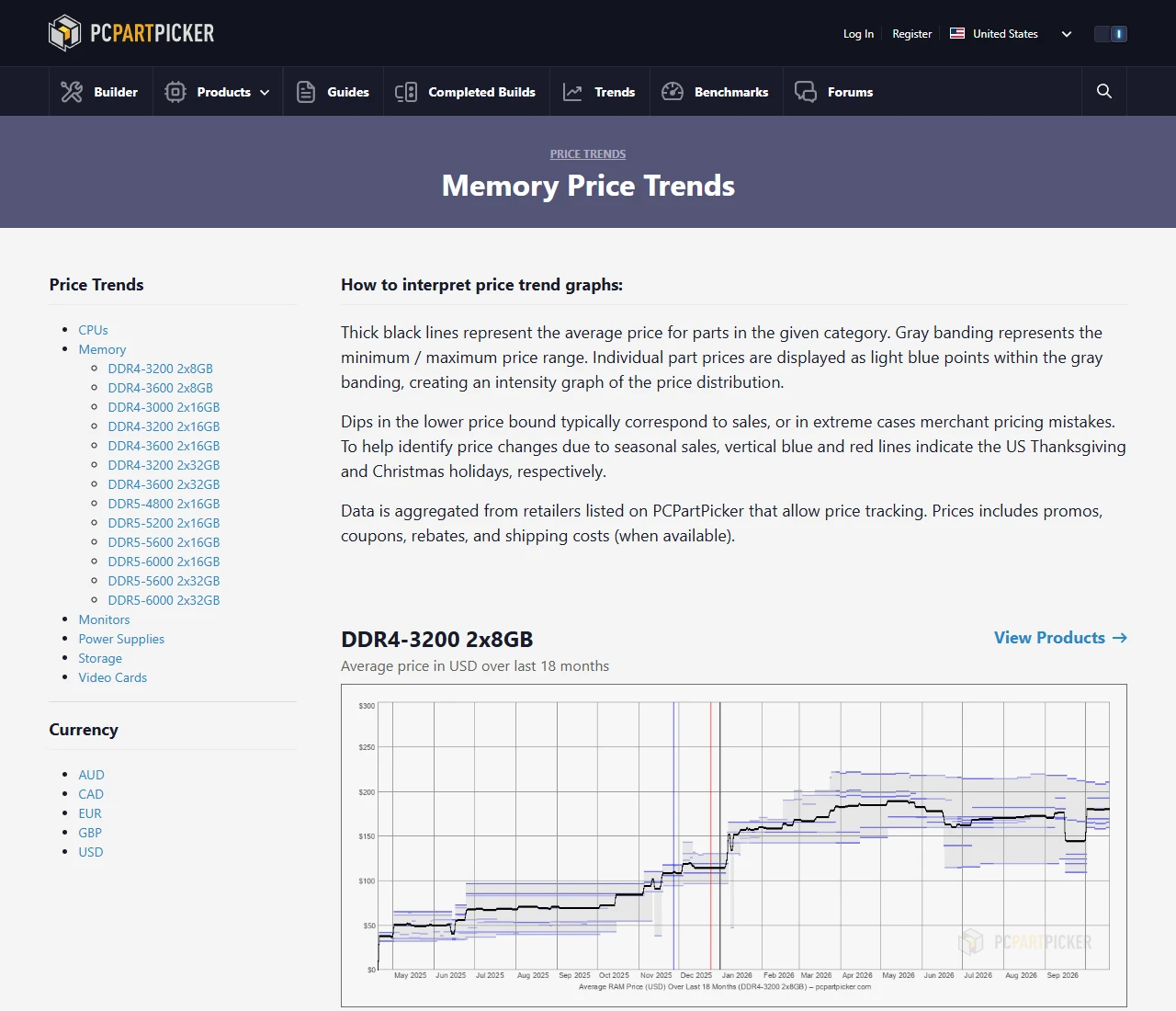
DDR4 has not escaped either. The chart below is PCPartPicker's memory price trends page. Its first graph tracks the average price of a DDR4-3200 2x8GB kit: around $40 in May 2025 and about $180 in October 2026, more than four times as much.
| Item | Before | October 2026 | Source |
|---|---|---|---|
| 32GB DDR5-6000 kit (2x16GB) | $400 in August 2026 | $449.97 (lowest price, Oct 14) | Tom's Hardware |
| 32GB DDR5-4800 kit | Once $80 | $399 | Tom's Hardware |
| DDR4-3200 2x8GB, average | About $40 in May 2025 | About $180 | PCPartPicker chart (read from the graph) |
| Conventional DRAM contract prices | Up for several quarters running | Forecast +10% to 15% QoQ in Q4 | TrendForce |
| NAND Flash contract prices (SSDs, phone storage) | Also rising | Forecast +15% to 20% QoQ in Q4 | TrendForce |
The retail figures are US prices. Other countries differ in the numbers but not the direction, and PCPartPicker lets you switch the chart to your own currency. Contract prices are what memory makers charge PC brands and module makers in bulk; retail prices usually follow them.
The increases are reaching finished PCs too. TrendForce's September 30 report says notebook inventories in the fourth quarter increasingly reflect higher component costs, which is weighing on sales, and Tom's Hardware cites figures showing PC shipments fell 20% year on year in the third quarter of 2026.
Why are RAM prices so high? AI servers took the capacity
Nearly all the world's computer memory comes from three companies: Samsung, SK hynix and Micron. Their fabs can only produce so many wafers, and each wafer goes to whichever product pays best. AI servers need two kinds of memory at once: high-bandwidth memory (HBM), stacked right next to the AI chip, and ordinary DDR5 server modules. Both earn more than memory for consumer PCs, so that is where capacity goes first.
HBM is also unusually hungry. At Hot Chips in August 2026, Micron's HBM design architecture fellow Raghu Sreeramaneni was reported as saying that for the same capacity, HBM uses roughly three times the wafer area of DDR5, and that newer HBM generations will not improve that ratio. Every extra gigabyte of HBM a fab makes means roughly three fewer gigabytes of regular memory.
The makers have said as much in public. On December 3, 2025, Micron announced it was leaving the Crucial consumer business, with retail shipments ending in February 2026, so it could “improve supply and support for our larger, strategic customers in faster-growing segments.” Crucial was the RAM and SSD brand many people bought for their own builds. In the quarter ending September 3, 2026, Micron's revenue was $54.23 billion, against $11.32 billion a year earlier, and its gross margin rose from 44.7% to 86.8%.
TrendForce's September report puts it plainly: suppliers keep giving advanced-process capacity to high-performance server products in the fourth quarter, the market stays undersupplied, and as more capacity shifts to servers, PC DRAM supply could fall in 2027.
When will RAM prices drop? What makers and analysts say
Nobody has published a date for prices to fall, and the signals point the same way:
- On Micron's September 30, 2026 earnings call, CEO Sanjay Mehrotra said the company has no line of sight to when supply and demand will return to balance. He expects demand to exceed supply in both 2027 and 2028, with both years tighter than 2026. About 75% of Micron's 2027 output is already spoken for.
- Micron plans new clean rooms in 2028, but Mehrotra said their output ramps up gradually and will not ease supply quickly.
- TrendForce expects fourth-quarter contract price rises to be smaller than earlier quarters, with conventional DRAM up 10% to 15%. Slower, but still rising.
Putting those together, our reading is that a clear drop is unlikely during 2027, and the more realistic point to watch is after new capacity starts coming online in 2028. That is our inference from what the makers have said, not anyone's published forecast. If you want to track it yourself, watch for three signals: TrendForce's end-of-quarter outlook moving from increases to flat or falling contract prices; Micron and SK hynix earnings no longer describing the market as undersupplied; and the average line on PCPartPicker's chart falling for several weeks in a row. Until those show up together, there is no need to check prices every day.
Should you buy RAM now or wait? It depends on your situation
| Your situation | What we suggest |
|---|---|
| Your PC works and you just want more RAM | Wait. Check the “Is 16GB enough” section first; most people already have enough |
| A stick has failed, or the PC is clearly short of memory | Buy now, but only the capacity you need today. Prices are not set to fall soon, so waiting will probably cost more |
| You are about to build a new PC | Compare the full cost of a prebuilt against building it yourself. Memory makers have been supplying PC brands under contract all year, so memory inside prebuilts may be rising more slowly than retail kits (our inference; compare actual prices before you order) |
| You are buying a laptop or a Mac | Get enough memory at purchase; many models have it soldered to the board |
| You are holding out for Black Friday | Keep an eye out, but do not expect a big drop. Tom's Hardware says the rare good deals often sell out within seconds |
| You want to stock up before prices climb further | We would not. Nobody knows which month prices peak, and extra sticks are a price bet you are taking on yourself |
Before you add RAM: slots, DDR4 vs DDR5, and soldered memory
On Windows, press Ctrl + Shift + Esc to open Task Manager, go to Performance and select Memory. The lower right shows three useful lines. Speed is the current memory speed. Slots used tells you whether you can add a stick: 2 of 4 means two slots are free, while 2 of 2 means you would have to replace what is there. Form factor says DIMM for desktop sticks and SODIMM for laptop sticks. This page does not show whether the memory is DDR4 or DDR5, so note your motherboard or laptop model and check the maker's spec page.
DDR4 and DDR5 are not interchangeable. The notch on the contacts sits in a different place, so neither fits the other's slot, and a motherboard supports only one type. Current platforms, AMD AM5 and Intel Core Ultra 200S, are DDR5 only; boards for Intel's 12th to 14th gen Core chips come in both versions, so it depends on the model.
On laptops, memory listed as LPDDR5 or LPDDR5X is almost always soldered to the board, and so is anything described as onboard, so you cannot add more later. Apple silicon Macs use unified memory, which also cannot be upgraded after purchase.
If you are adding a stick to a PC, match the capacity and speed of the one already there, ideally the same model. Mixed sticks often run at the slower one's speed and sometimes will not boot together, so buy from a seller that accepts returns.
Is 16GB of RAM enough in 2026?
First check whether you are actually short. In Task Manager's Memory page, look at In use while you have your usual apps open. If it stays above roughly 80% and the PC feels sluggish, you need more; brief spikes do not count. The table below is our suggestion for common uses, not a hardware standard.
| What you do | Suggested RAM |
|---|---|
| Browsing, office work, streaming | 8GB works but is tight; 16GB is comfortable. Windows 11's official minimum is 4GB |
| Gaming | 16GB to start; check the recommended specs on the game's store page before you buy |
| Video editing, large photo files, many apps open at once | 32GB |
| Running AI models on your own PC | 16GB for models around 8B, 32GB or more beyond that; see the memory section of our NPU and AI PC explainer |
If you are short but do not want to spend yet, turn off apps that launch at startup and keep fewer browser tabs open. Tabs are often the biggest memory user, and both Chrome's Memory Saver and Edge's sleeping tabs put tabs you have not looked at for a while to sleep; switch them on in the browser's settings.
If you have to buy now, how to avoid overpaying
Compare before you order. PCPartPicker and Tom's Hardware's price tracker both list current lowest prices, which shows quickly whether the kit you picked is out of line. A slightly slower kit is often much cheaper: in Tom's Hardware's October report, a 32GB DDR5-5200 kit cost about $50 less than the cheapest DDR5-6000 one, a gap you will not notice in everyday use.
If you buy used, keep a way out. Choose a seller that accepts returns, and after installing, check capacity, speed and slots in Task Manager against the listing. If something does not match, send it back within the return window.
If you own Crucial memory or SSDs, your warranty still stands: Micron's announcement says it will keep providing warranty service and support for Crucial products.
SSDs are rising too. TrendForce expects NAND Flash contract prices to climb 15% to 20% quarter on quarter in the fourth quarter, so if you are replacing a drive as well, buy the size you need rather than the size you might need someday.
FAQ
When will RAM prices go back to normal?
There is no firm date. Micron said in September 2026 that supply will be tighter in both 2027 and 2028 than in 2026, and that its new clean rooms open in 2028 and ramp up gradually. On that basis, a clear drop during 2027 looks unlikely; the more realistic point to watch is after new capacity comes online in 2028.
Is 16GB of RAM enough in 2026?
For browsing, office work, streaming and most games, yes. For video editing or lots of apps at once, 32GB is the safer choice, and for running AI models locally, 16GB handles models around 8B. Check whether Task Manager's In use figure stays above roughly 80% before deciding to add more.
DDR4 or DDR5 for a new build in 2026?
On new platforms there is no choice: AMD AM5 and Intel Core Ultra 200S support DDR5 only. DDR4 has also risen more than fourfold, so it is no longer the cheap way out. If you already own a DDR4 board, keeping it is the cheapest route; for a completely new build, go DDR5.
Will there be cheap RAM on Black Friday?
There may be scattered discounts, but do not expect last year's prices. TrendForce forecasts contract prices still rising in the fourth quarter, and the few good retail deals tend to sell out quickly. If you really need memory, buy when you see a fair price rather than holding out for a sale.
Why are SSD prices going up as well?
SSDs use NAND Flash, which AI data centers are also buying in bulk. TrendForce expects NAND contract prices to rise 15% to 20% quarter on quarter in the fourth quarter, with enterprise SSDs rising fastest. Buy the capacity you need now rather than stocking up.
Sources and further reading
- TrendForce, AI Server Demand Sustains Memory Contract Price Increases in 4Q26 (September 30, 2026): conventional DRAM up 10% to 15% QoQ, NAND up 15% to 20%, and PC DRAM supply that could decline in 2027
- Micron, Micron Announces Exit from Crucial Consumer Business (December 3, 2025) and its fiscal Q4 2026 results release (September 30, 2026)
- The Next Web, ‘No line of sight’ to the end of the memory shortage, Micron says (October 2, 2026): earnings call comments on 2027 and 2028 supply and new clean rooms
- Igor's Lab, Micron: HBM Requires Three Times More Wafer Area Than DDR5 (August 26, 2026), reporting on the Hot Chips 2026 talk
- Tom's Hardware, 32GB of DDR5 6000 RAM now costs $450 (October 14, 2026) and its RAM price tracker; PCPartPicker, Memory Price Trends
Updated: First published October 19, 2026. Memory prices move every week; we will note it here when TrendForce publishes a new quarterly outlook or prices clearly turn.

Fang Yu is the editor of FutureLens, turning published papers, official materials and public explanations into plain-language notes. He is most interested in the gap between a technology's public pitch and the evidence a careful reader can actually check. More about the author