Sodium-ion vs lithium-ion battery: what is the difference, the pros and cons, and are sodium-ion cars worth it?
Sodium-ion is not an upgrade on lithium-ion. It is a different trade-off: better in the cold and free of lithium, at the cost of storing less energy for its weight.
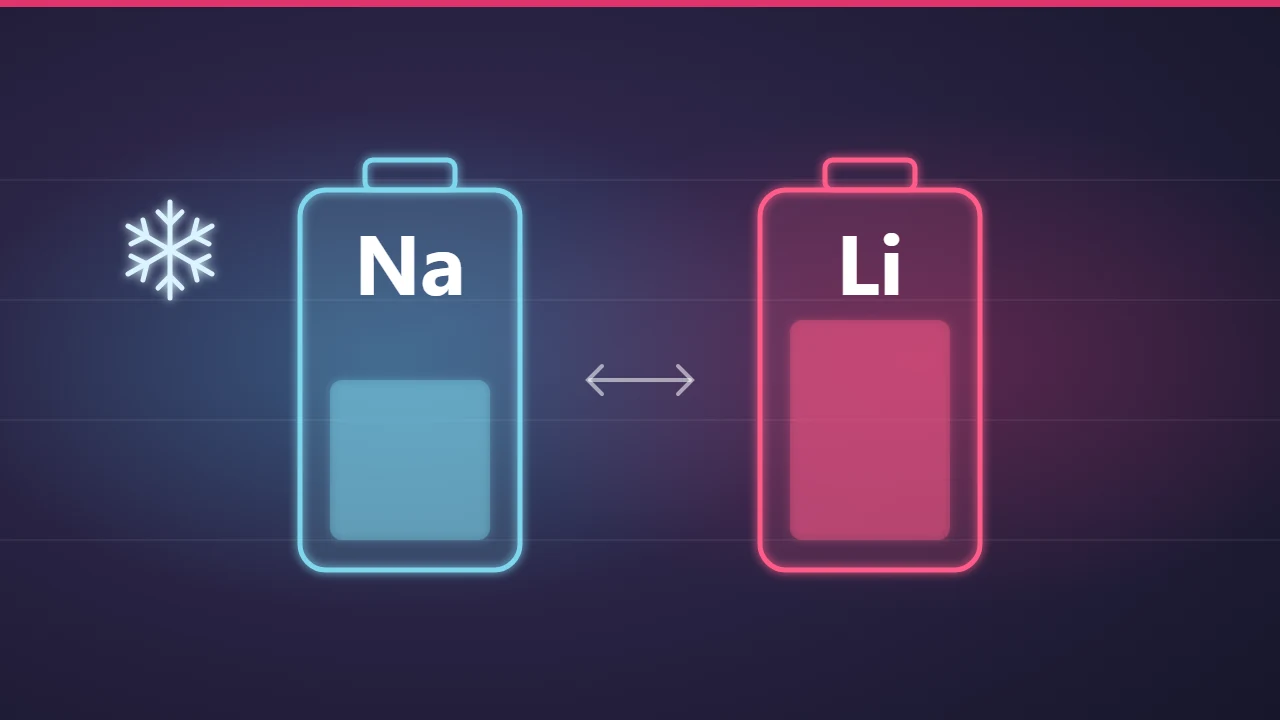
A sodium-ion battery works almost exactly like a lithium-ion one: ions shuttle between the two electrodes as it charges and discharges. The difference is that the ion is sodium, which is cheap and found almost everywhere. Its strengths are that it loses less power in the cold and does not depend on the price of lithium. Its weakness is that it stores less energy for its weight: the best mass-production figure today is the 175 Wh/kg CATL claims, which is below long-range lithium-ion cells. In practice, if you live somewhere with hard winters, drive short distances and care about price, a sodium-ion car or e-scooter is worth a look. If you drive long distances or want maximum range, lithium-ion is still the safer choice. Before you buy anything labelled sodium-ion, check the battery type, capacity and cold-weather charging details on the spec sheet. The details are below.
- What is a sodium-ion battery? Lithium swapped for sodium
- Sodium-ion vs lithium-ion battery: the differences in one table
- Sodium-ion battery pros and cons
- Are sodium-ion batteries better in the cold? Discharging and charging are different
- Are sodium-ion cars worth buying? What you can get now
- E-scooters, power banks and home backup: where else sodium-ion is used
- Five things to ask before you buy a sodium-ion product
- FAQ
What is a sodium-ion battery? Lithium swapped for sodium
In the lithium-ion battery in your phone or car, lithium ions move from the cathode to the anode when you charge it and move back when you use it. A sodium-ion battery follows the same route with sodium ions instead. Sodium is the sodium in table salt. There is plenty of it in rock and seawater, and unlike lithium it is not concentrated in a handful of countries' mines. That is the first reason the industry is interested.
Swapping the ion means swapping a few parts too. Sodium ions are larger and heavier than lithium ions and do not fit well into the graphite anodes lithium-ion cells use, so sodium-ion anodes are usually made of hard carbon. The other change is the current collector, the metal foil behind each electrode. Lithium-ion cells need copper foil on the anode side; sodium-ion cells can use cheaper, lighter aluminium on both sides. Battery research papers point to a benefit that follows from this: a sodium-ion cell with aluminium foil can be discharged to 0 volts for storage and shipping, while taking a lithium-ion cell that low corrodes its copper foil.
The cost also comes from the ion itself. For the same weight, sodium ions carry less charge, so sodium-ion cells start with lower energy density. That decides where they go first: uses where weight matters less and cost and cold performance matter more.
Sodium-ion vs lithium-ion battery: the differences in one table
There are two common kinds of lithium-ion battery. LFP (lithium iron phosphate) is cheap and durable and sits in many budget EVs and storage systems. NMC (nickel manganese cobalt) stores more energy and is used in long-range cars. The table compares sodium-ion with both. The sodium-ion figures are manufacturer numbers, not results from a common independent test, so read them as a rough guide.
| Comparison | Sodium-ion | LFP lithium-ion | NMC lithium-ion |
|---|---|---|---|
| Energy density (cell) | CATL claims up to 175 Wh/kg; the cells in Yadea's e-scooters are above 145 Wh/kg | Commonly around 160 to 200 Wh/kg, varies a lot by model | Higher; used in most long-range cars |
| Cold-weather discharge | A strength. CATL says over 90% capacity at −40°C (−40°F) | Range drops clearly at −20 to −30°C | Somewhat better than LFP |
| Cold-weather charging | Still a weak point, independent research agrees | Also slow in the cold | Also affected |
| Materials | Sodium and aluminium, widely available, unaffected by lithium prices | Needs lithium | Needs lithium, plus nickel and cobalt |
| Maturity | Mass production just starting, few models | Very mature | Very mature |
Put simply, sodium-ion now reaches roughly the lower half of the LFP range and is still well behind NMC. It competes mainly for LFP's share of the market and will not replace the batteries in long-range cars any time soon.
Sodium-ion battery pros and cons
There are four advantages. First, it handles cold well and loses less discharge power in winter, which is the best-supported claim so far. Second, the materials are everywhere, so lithium shortages or price spikes do not touch it. Third, safety tests look good: CATL says its sodium-ion cells did not smoke or catch fire when crushed, drilled or sawn, and coverage of Elecom's sodium-ion power bank also describes a lower fire risk, though these are the makers' own tests and claims. Fourth, it can be discharged to 0 volts, which makes shipping and storage simpler.
The disadvantages are just as clear. It stores less energy for its weight, so in a car you get either less range or a heavier pack. Charging in the cold is still hard. The industry is young: there are few cars and products to choose from, and no track record yet on repairs or resale value. The cost advantage is not guaranteed either. The raw materials are cheap, but volumes are still small, so the manufacturing cost per cell may not be low yet, and lithium carbonate prices have swung wildly in recent years. When lithium is cheap, sodium-ion's price edge shrinks (that is our inference, not an estimate from any research firm).
One independent test is worth knowing about. In June 2026, a team at RWTH Aachen University in Germany published a study in Cell Reports Physical Science, a Cell Press journal, after testing 120 commercial sodium-ion cells made by China's HiNa Battery. They found uniformity and build quality comparable to Tesla's lithium-ion cells, and better-than-expected performance at high current and low temperature. The researchers also wrote that low-temperature charging remains a clear weakness and that energy density still trails the best lithium-ion cells. They see these cells as best suited to stationary storage, grid services, and shorter-range or commercial vehicles.
Are sodium-ion batteries better in the cold? Discharging and charging are different
"Good in the cold" mostly refers to discharge, meaning how much power the battery can deliver while you drive or ride. CATL's figures: at −30°C (−22°F), discharge power is nearly three times that of a comparable LFP battery, and at −40°C (−40°F) it keeps over 90% of its capacity. Yadea's e-scooter battery is rated to keep over 92% of its discharge capacity at −20°C (−4°F). If winter range loss bothers you, sodium-ion does help on this point.
Charging is another matter. The RWTH Aachen study lists cold charging as a clear weakness, and the team's next goal is safer charging below 0°C (32°F). For everyday use we suggest the following: charge in a garage or underground car park in winter when you can; charge right after driving while the battery is still warm, which is faster than charging after it has sat in the cold all night; and before buying a car, ask whether it has battery preheating and roughly what fast-charging power it gets at −10°C (14°F) and −20°C (−4°F). If the salesperson cannot answer, ask for the manufacturer's written figures.
Are sodium-ion cars worth buying? What you can get now
For passenger cars, the clearest news comes from CATL and Changan in China. On February 5, 2026, in Yakeshi, Inner Mongolia, the two companies unveiled what they called the world's first mass-production passenger car with sodium-ion batteries, with a pure-electric range of more than 400 km (about 250 miles). CATL's announcement said the car would reach the market by mid-2026, and that its Naxtra sodium-ion batteries will go into all of Changan's brands: AVATR, Deepal, Qiyuan and UNI.
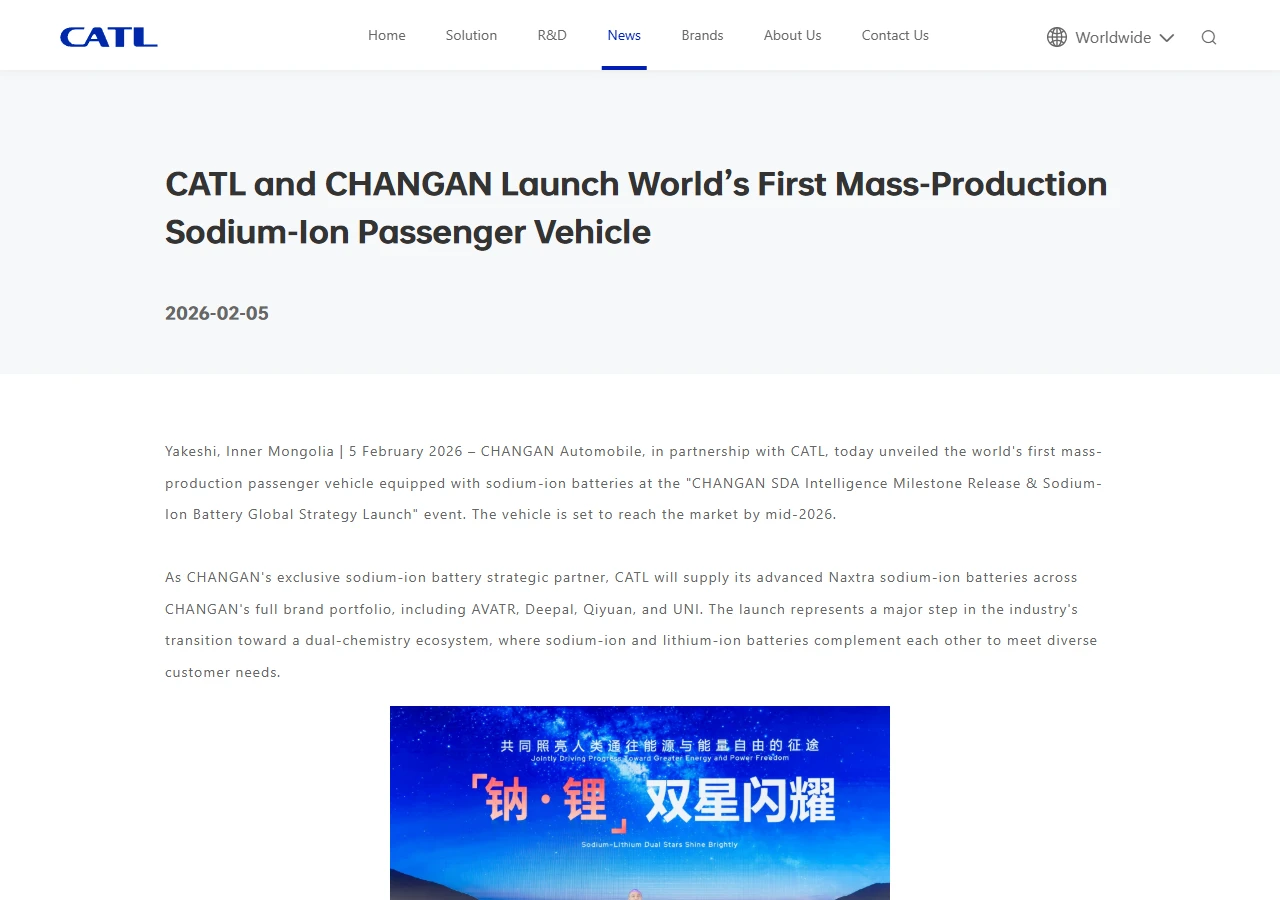
One phrase in that release is worth noticing. The companies call this the start of a "dual-chemistry" era: sodium-ion and lithium-ion batteries are meant to sit side by side, each covering different needs, not one replacing the other. CATL projects that sodium-ion packs could eventually reach 500 to 600 km for pure EVs and 300 to 400 km for range-extended and hybrid cars, covering more than half of new-energy-vehicle range needs. That is a company plan, not cars already on the road.
Whether one suits you depends on how you drive:
| Your situation | Our suggestion |
|---|---|
| Winters often reach −15 to −20°C and you mostly drive in town | Worth serious thought; cold performance is its strength |
| Tight budget, shopping for an entry-level car | Add it to the shortlist and compare real range and price with LFP cars at the same price |
| Frequent motorway or long road trips | Not the first choice for now; less stored energy means more charging stops |
| Keen to be an early owner but worried about resale value | Wait a while and watch owner feedback and used prices over the first year or two |
Outside China, sodium-ion passenger cars are not widely sold yet. If you are elsewhere, the same checks apply when one reaches your market.
E-scooters, power banks and home backup: where else sodium-ion is used
Electric two-wheelers were among the first places sodium-ion reached ordinary buyers. In January 2025, Yadea, a large Chinese e-scooter maker, launched sodium-ion models in Hangzhou together with its own fast-charging network. Its published battery figures: energy density above 145 Wh/kg, 1,500 cycles at room temperature, 80% charge in as little as 15 minutes at its own fast-charging stations, and a promise of "five years of life, replacement within three". Yadea said the bikes had already been piloted in Shenzhen, Chongqing and other cities. If you are considering one, check first whether those charging stations are on your usual routes; if not, fast charging will not mean much to you.
In March 2025, Japan's Elecom launched what it called the world's first sodium-ion power bank: 9,000 mAh, up to 45 W over USB-C, rated for 5,000 cycles and usable from about −34°C to 50°C (−30°F to 122°F). It was sold only in Japan at launch. 9,000 mAh is a middling capacity for a power bank; the reason to buy one is cold tolerance and lifespan, not capacity.
Storage is the other big hope for sodium-ion, for the reason given above: a battery that stays in one place can be heavy, and what matters is cost, lifespan and safety. The RWTH Aachen authors also put storage and grid services at the top of their list. Sodium-ion batteries sold for home backup are still rare, though. If you are shopping for home backup, check that the product carries the safety certification your country uses for home energy storage (in the US, look for a UL 9540 listing), and ask about the warranty period and rated cycle count.
Five things to ask before you buy a sodium-ion product
- Is the battery really sodium-ion? The battery type on the spec sheet or in the manual should say sodium-ion. If the marketing says sodium but the spec sheet says something else, trust the spec sheet and ask.
- How big is the battery, in kWh or Ah, and what is the real range? For a car, look at both the official range and the winter range; for an e-scooter, ask how far a full charge goes in your local weather.
- How does it charge in the cold? Whether it can fast-charge below freezing, whether it preheats, and how long a full charge takes.
- How long will it last, and what if it fails? Cycle count, warranty years and mileage, and roughly what a replacement battery costs.
- Is charging and service close to you? How far the nearest charging or swap stations and repair shops are from where you usually go.
Once you have those answers, compare real range and total price with a lithium-ion product at the same price and the choice usually becomes clear.
FAQ
Will sodium-ion batteries replace lithium-ion?
Not any time soon. Sodium-ion stores less energy for its weight, so long-range cars, phones and laptops will stay with lithium-ion. CATL and Changan themselves describe a "dual-chemistry" future where both coexist, with sodium-ion taking part of LFP's market: cold regions, budget cars, e-scooters and energy storage.
How long do sodium-ion batteries last?
It depends on the product. Yadea rates its e-scooter battery at 1,500 cycles at room temperature, and Elecom rates its power bank at 5,000 cycles; both are manufacturer figures. Before buying, read the cycle count and warranty terms in the manual. The warranty period tells you more than any lifespan claim in an advert.
Are sodium-ion batteries safe, or can they catch fire?
Manufacturer tests look good: CATL says its sodium-ion cells did not smoke or catch fire when crushed, drilled or sawn. But any battery can fail if it is badly damaged, gets wet or is charged with a poor-quality charger, and sodium-ion is no exception. Follow the manual and avoid unknown chargers, the same as with lithium-ion.
How do sodium-ion cars do in winter?
Discharge holds up better in the cold than lithium-ion; CATL says its cells keep over 90% capacity at −40°C (−40°F), so winter range loss should be smaller than in an LFP car. Cold charging is still a weak point. Before buying, ask for the winter range and the fast-charging power in sub-zero weather, and look for feedback from owners who drive in winters like yours.
What is the difference between sodium-ion and solid-state batteries?
They change different parts of the battery. Sodium-ion changes the ion that moves back and forth, from lithium to sodium. Solid-state changes the electrolyte, from a liquid to a solid. Sodium-ion is already in mass production and competes on cost and cold performance; all-solid-state batteries aim for higher energy density and are still ramping up. See why solid-state batteries are hard to mass-produce for more.
Sources and further reading
- CATL, CATL and CHANGAN Launch World’s First Mass-Production Sodium-Ion Passenger Vehicle (February 5, 2026): 175 Wh/kg, range above 400 km, figures at −30°C and −40°C, safety tests and launch timing
- ScienceDaily, Chinese sodium battery surprised scientists by matching key Tesla benchmarks (June 21, 2026): the RWTH Aachen study of HiNa cells in Cell Reports Physical Science
- Xinhua, Yadea sodium-ion e-scooter and fast-charging network launch (January 7, 2025, in Chinese): energy density, cycle life, cold and fast-charging figures
- Interesting Engineering, World-first sodium-ion power bank with 9,000-mAh capacity (March 19, 2025): Elecom's capacity, cycle and temperature figures
Updated: First published October 29, 2026. We will note it here when sodium-ion car models launch, prices are announced or new independent tests appear.

Fang Yu is the editor of FutureLens, turning published papers, official materials and public explanations into plain-language notes. He is most interested in the gap between a technology's public pitch and the evidence a careful reader can actually check. More about the author